Nevada Teaching Salaries and Benefits

Nevada teachers earn a median annual salary between $65,040 and $66,300 depending on grade level, according to May 2025 Bureau of Labor Statistics data. Beyond the paycheck, teachers employed by Nevada public school districts generally participate in the state’s Public Employees’ Retirement System, which pays a lifetime monthly pension after retirement, and most public school districts offer health insurance, with many plans including dependent coverage.
Sponsored School(s)


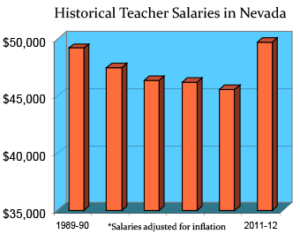
Some would-be teachers get scared away from the profession by reports that educators don’t earn competitive salaries. Those reports, often based on incomplete comparisons, tend to skip the substantial benefits teachers receive on top of their base pay.
With a pension that pays out for life and insurance options that support a teacher’s whole family, Nevada teachers have real financial stability built into the job. That’s true across the state, since Nevada teachers receive benefits negotiated at both the state and local district level.
If you’re weighing a move into the classroom, connect with schools offering educator preparation programs that meet Nevada licensure requirements. Already licensed in another state? Check the requirements for out-of-state teachers considering Nevada before you apply.
Teacher Salaries in Nevada by Grade Level
Pay varies by the age group a teacher works with, and it climbs as teachers gain experience and move up their district’s salary schedule. Here’s how median and average annual wages break down by grade level statewide:
| Occupation | Median Annual Wage | Mean Annual Wage |
|---|---|---|
| Kindergarten Teachers | $64,930 | $66,570 |
| Elementary School Teachers | $65,040 | $65,840 |
| Middle School Teachers | $66,300 | $68,810 |
| Secondary (High) School Teachers | $65,520 | $68,570 |
Top earners in these roles clear $82,670 to $83,190 a year at the 90th percentile, according to the same BLS data. That range mostly reflects years on the job, advanced degrees on the salary schedule, and stipends for extra duties like coaching or department leadership. Nevada-specific job growth projections for these occupations aren’t published at the state level. For current hiring outlook and open positions, check directly with individual Nevada school districts.
Retirement Benefits Through Nevada PERS
Teachers hired by Nevada public school districts generally participate in PERS, subject to applicable employment classification and state law. PERS offers a statewide defined benefit plan for teachers, meaning you earn lifetime monthly pension payments once you retire.
Monthly payments start once you reach normal retirement age and end your employment. Under current PERS rules, members generally qualify for an unreduced retirement benefit if they meet any of the following:
- At age 65 with five years of service
- At age 62 with 10 years of service
- At any age with 30 years of service
Pension benefits don’t come free, though how a teacher pays into PERS depends on which plan their employer uses. Most Nevada school teachers contribute under the Employer-Pay plan, where the district covers the full contribution on the teacher’s behalf, currently 33.50% of salary. Some public employees instead participate under the Employee/Employer plan, which splits the contribution evenly, currently 17.50% each. Contact your district or PERS directly to confirm which plan applies to your position.
As a defined benefit plan, PERS doesn’t calculate your payout from your own contributions. Instead, it uses a formula set by the state legislature. While the formula can change over time, you can estimate your likely benefit this way:
Years of Service multiplied by 2.5% multiplied by Final Average Monthly Salary
For example, a teacher who retires after 20 years of service with an average monthly salary of $3,000 would qualify for roughly $1,500 a month in pension payments.
Nevada teachers have several options for how monthly benefits pay out, including deferring a portion to a beneficiary. For current details on these options, contact the Public Employees Retirement System directly.
Health Insurance and Other Benefits
In Nevada, teachers unions bargain for health insurance benefits at the local school district level. Exact coverage depends on those negotiations, but most districts offer teachers some level of health insurance.
The Clark County School District, one of the largest school districts in the country, offers teachers a range of health insurance options through the Teachers Health Trust as one example of what a Nevada district benefits package can look like.
Teachers typically choose between several coverage tiers that differ in cost and who the plan covers. Many plans include dependent coverage, though this varies by district and plan.
Coverage commonly includes:
- Hospital Visits
- Diagnostic Testing
- Office Visits
- Physician Services
- Preventative/Routine Care
Some plans also extend to dental and vision care. Contact your local school district directly to confirm your exact benefits before accepting a position.
Frequently Asked Questions
How much do teachers make in Nevada?
Nevada teachers earn a median annual salary ranging from $64,930 for kindergarten teachers to $66,300 for middle school teachers, according to May 2025 BLS data. Pay increases with experience, advanced degrees, and district-specific salary schedules.
What retirement benefits do Nevada teachers get?
Teachers employed by Nevada public school districts generally participate in the Public Employees’ Retirement System (PERS), a defined benefit plan that pays a lifetime monthly pension after retirement. Payouts are based on years of service and final average monthly salary, not on individual contributions.
When can a Nevada teacher retire with full PERS benefits?
Under current PERS rules, members generally qualify for an unreduced retirement benefit at age 65 with five years of service, at age 62 with 10 years of service, or at any age with 30 years of service. These rules are set by state law and can change.
Do Nevada teachers get health insurance?
Most Nevada public school districts offer health insurance, negotiated locally by teachers unions. The Clark County School District, for example, offers coverage through the Teachers Health Trust, and many plans include dependent coverage.
Do Nevada teacher salaries vary by district?
Yes. Base pay follows each district’s own salary schedule, which factors in years of experience and education level. Benefits like health insurance are also negotiated at the district level, so coverage can differ from one Nevada district to another.
- Pay varies by grade level — Nevada’s median annual teacher salary ranges from $64,930 to $66,300 depending on whether you teach kindergarten, elementary, middle, or high school, per May 2025 BLS data.
- PERS pays a lifetime pension — teachers employed by Nevada public school districts generally participate in the Public Employees’ Retirement System, which calculates retirement pay from years of service and final average salary, not individual contributions.
- Full retirement has three paths — under current PERS rules, members generally qualify for an unreduced benefit at 65 with five years of service, 62 with 10 years, or at any age with 30 years of service.
- Health coverage is set locally — insurance benefits come from district-level union negotiations, so exact coverage and cost depend on where in Nevada you teach.
Ready to start a teaching career in Nevada? Connect with schools offering educator preparation programs that lead to Nevada licensure.

May 2025 US Bureau of Labor Statistics OEWS wage estimates and 2024-2034 employment projections for Kindergarten and Elementary School Teachers, Middle School Teachers, and High School Teachers, reflect state and national data, not school-specific outcomes. State or district job-growth projections are sourced separately from national BLS outlook data. Conditions vary by school sector, subject area, and district. Data accessed July 2026.