Arkansas Teaching Salaries and Benefits

Arkansas teachers join the Arkansas Teacher Retirement System (ATRS), a defined benefit pension based on years of service and final average salary. Median pay ranges from $52,060 for kindergarten teachers to $59,660 for secondary teachers, according to BLS data. Teachers can retire at 28 years of service or age 60, and remain covered by Social Security.
Sponsored School(s)


Arkansas teachers get a fuller compensation picture than salary alone. Between the state’s defined benefit pension, health coverage through ARBenefits, and a base salary tracked by BLS wage data, the state builds in more long-term security than its headline pay numbers suggest. This guide breaks down what Arkansas teachers actually earn, how the state retirement system works, and what health coverage looks like on the job.
Teacher licensure in Arkansas is issued by the Arkansas Department of Education’s Division of Elementary and Secondary Education (DESE). See Arkansas educator licensure requirements for the specific pathways and paperwork involved.
Learn more about becoming a teacher. Contact schools offering teacher preparation (educator preparation) programs in Arkansas.
Teacher Salaries in Arkansas
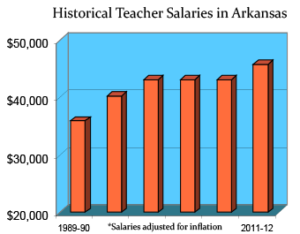
Arkansas school districts set base pay through locally negotiated salary schedules that reward years of experience and advanced degrees, so your actual paycheck depends on your district as much as your grade level. Statewide, BLS wage data gives the clearest independent picture of what different teaching roles pay on average.
| Occupation | Median Annual Wage | Job Growth (2024–2034) |
|---|---|---|
| Kindergarten Teachers | $52,060 | 12.0% |
| Elementary School Teachers | $52,700 | 11.9% |
| Middle School Teachers | $59,570 | 11.6% |
| Secondary (High) School Teachers | $59,660 | 11.9% |
According to the Bureau of Labor Statistics, Arkansas elementary school teachers earned a median annual salary of $52,700 as of May 2025, while secondary teachers earned $59,660. All four teaching categories are projected to grow faster in Arkansas than the national average over the same period, which trends flat to slightly negative nationally.
For district-specific pay scales showing how years of experience and advanced degrees affect your paycheck, check your local school district’s published salary schedule or contact the Arkansas Department of Education directly. Schedules vary enough between districts that a single statewide table can’t capture what you’ll actually see on a pay stub.
Retiring in Arkansas
Teachers in Arkansas join the Arkansas Teacher Retirement System (ATRS) as a condition of employment at any ATRS-covered public school or university. Established in 1937, ATRS is a defined benefit plan, meaning it guarantees a set monthly payment for life once you qualify, rather than depending on how your individual contributions perform in the market.
You become vested after five years of credited service. From there, you can retire and start drawing benefits under one of these paths:
- 28 or more years of service, at any age
- 25 to 27 years of service, at any age, with an early retirement reduction (10% for each year short of 28 years of service, or each year short of age 60, whichever is less)
- Five to 24 years of service, once you reach age 60
ATRS offers two contribution paths. Contributory members pay 6% of their salary into the retirement fund, and their employer matches that amount. The employee’s contributions earn interest, but the employer match doesn’t. Non-contributory members skip the salary deduction but receive a lower benefit multiplier in retirement.
Both paths use the same basic formula:
Years of Service Credit
multiplied by
Final Average Salary (Three highest years)
multiplied by
Multiplier (1.39% Non-contributory) (2.15% Contributory)
For example, a contributory member who worked 25 years with a final average salary of $40,000 would be looking at an estimated monthly benefit of roughly $1,866.67.
ATRS no longer runs a standalone public benefit calculator. Members can request a personalized estimate by signing into their ATRS My Account portal or by contacting an ATRS counselor directly.
One detail that surprises teachers moving from other states: Arkansas public school employees have participated in Social Security since 1951, under state law. Most other states either fully exclude teachers from Social Security or blend it differently with their pension, so if you’ve worked exclusively in Arkansas public schools, the Windfall Elimination Provision and Government Pension Offset penalties that affect teachers elsewhere don’t apply to you.
ATRS handles the pension, but not retiree health insurance. That falls under the Arkansas Employee Benefits Division, through the ARBenefits Retiree program, which coordinates with Medicare Parts A and B. More information on these benefits is available from the Employee Benefit Division.
Health Insurance for Arkansas Teachers
Working teachers get health coverage through the ARBenefits program, administered by the Arkansas Department of Shared Administrative Services. ARBenefits currently offers three plan levels for public school employees: Premium, Classic, and Basic, each striking a different balance between premium cost, deductible, and out-of-pocket maximum. The Premium plan carries the lowest deductible for in-network care, while the Classic and Basic plans qualify for Health Savings Accounts in exchange for a higher deductible.
Across all three plan levels, ARBenefits generally covers the same core categories of care:
- Preventive Care
- Physician Services
- Hospital Admissions and Outpatient Care
- Prescription Drug Coverage
- Behavioral and Mental Health Services
- Rehabilitation
- Emergency Care
Some services typically fall outside standard coverage regardless of plan level, including elective cosmetic procedures, dental care, vision care, and long-term care, which Arkansas teachers usually need to add through supplemental coverage.
Plan costs and coverage details change with each enrollment year, so don’t rely on last year’s premium or deductible figures. Contact ARBenefits for current rates and a full plan comparison.
Frequently Asked Questions
What retirement system do Arkansas teachers use?
Arkansas public school teachers join the Arkansas Teacher Retirement System (ATRS), a defined benefit pension plan established in 1937. ATRS guarantees a monthly benefit for life based on your years of service and final average salary, rather than tying your payout to how your individual contributions perform in the market.
How much do Arkansas teachers earn?
Median pay varies by grade level. According to May 2025 BLS data, kindergarten teachers earn a median of $52,060, elementary teachers $52,700, middle school teachers $59,570, and secondary teachers $59,660 annually in Arkansas. Actual pay also depends on your district’s salary schedule, which factors in years of experience and advanced degrees.
When can Arkansas teachers retire with full benefits?
You qualify for an unreduced ATRS benefit once you reach 28 years of service at any age, or age 60 with at least five years of service. Retiring with 25 to 27 years of service is possible but triggers an early retirement reduction.
Do Arkansas teachers pay into Social Security?
Yes. Arkansas has required Social Security participation for public school employees since 1951, which sets it apart from roughly 15 other states where teachers are excluded from or only partially covered by Social Security.
What health insurance is available to Arkansas teachers?
Working teachers enroll in the ARBenefits program through the Arkansas Department of Shared Administrative Services, choosing between Premium, Classic, and Basic plan levels. Retirees access a separate ARBenefits Retiree plan that coordinates with Medicare Parts A and B.
- ATRS is a defined benefit pension, not a 401(k) — your payout depends on years of service and final average salary, not market returns on your own contributions.
- Full retirement kicks in at 28 years of service or age 60 — retiring with 25 to 27 years of service triggers an early retirement reduction.
- Arkansas teachers keep Social Security — unlike teachers in roughly 15 other states, Arkansas public school employees have participated in Social Security since 1951.
- Salary and health coverage come from separate systems — ATRS manages your pension, while the SAS Employee Benefits Division runs ARBenefits health coverage for both active teachers and retirees.
Find Arkansas teacher preparation programs and learn about Arkansas educator licensure requirements, application steps, and timelines.

May 2025 US Bureau of Labor Statistics OEWS wage estimates and 2024-2034 employment projections for Kindergarten and Elementary School Teachers, Middle School Teachers, and High School Teachers, reflect state and national data, not school-specific outcomes. State or district job-growth projections are sourced separately from national BLS outlook data. Conditions vary by school sector, subject area, and district. Data accessed July 2026.