
Teacher Salaries and Benefits by State

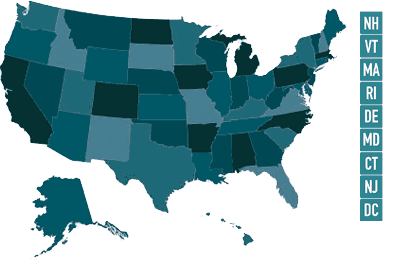
Teacher pay and benefits differ by state because each state funds its own school systems and runs its own retirement and health insurance programs. Elementary school teachers earned a median annual salary of $63,970 nationally as of May 2025, according to the Bureau of Labor Statistics, but state averages range from the low $50,000s to the mid $90,000s. Select your state below for exact salary figures, retirement plan details, and health insurance information.
Sponsored School(s)


No two states pay teachers the same way. Each state legislature sets its own school funding formula, so base salaries, step increases, and the retirement and health benefits attached to them vary from state to state and often from district to district within the same state. For a broader look at teacher salaries and benefits, including how these figures compare nationally, see our overview guide before checking your state’s specifics below.
Teacher Salaries Vary Widely by State
According to the Bureau of Labor Statistics, elementary school teachers earned a median annual salary of $63,970 nationally as of May 2025, with an annual mean wage of $72,650. Middle school teachers earned a median of $64,370, and high school teachers earned a median of $72,040. Those national figures mask significant state-level differences driven by school funding levels, cost of living, and local demand for teachers.
| Highest-Paying States | Mean Annual Salary |
|---|---|
| Washington | $97,970 |
| California | $95,670 |
| District of Columbia | $93,910 |
| New York | $93,400 |
| Massachusetts | $88,720 |
| Lowest-Paying States | Mean Annual Salary |
|---|---|
| Mississippi | $52,300 |
| Oklahoma | $52,320 |
| South Dakota | $52,680 |
| North Carolina | $54,070 |
| West Virginia | $54,890 |
Figures above reflect BLS annual mean wages for elementary school teachers by state as of May 2025. A higher salary doesn’t always mean more take-home value. Washington and California both rank near the top of the pay scale, but they also carry a much higher cost of living than states like Mississippi or Oklahoma, so the gap in real purchasing power is smaller than the raw numbers suggest.
How Teacher Benefits Differ by State
Retirement plans are the biggest source of variation. Many states run a defined benefit pension calculated from a formula like years of service multiplied by a percentage multiplier multiplied by final average salary, but the multiplier, vesting period, and eligibility age are set independently by each state’s retirement system. Other states, like Washington, offer a hybrid plan that combines a pension with a 401(k)-style account, and some states offer a defined contribution option instead of or alongside the traditional pension for certain teachers, so check your specific state’s plan structure rather than assuming a single model applies.
Health insurance works differently too. Some states negotiate a single statewide health plan for all public school employees, but benefit administration varies widely, and in many states individual school districts choose their own carriers and plan options instead. That means two teachers in the same state can have very different coverage depending on their district.
Because these programs are state-specific, the most reliable way to check your numbers is to look up your own state’s teacher retirement system and health benefits program directly rather than relying on a national average.
Pick Your State
- Alabama
- Alaska
- Arizona
- Arkansas
- California
- Colorado
- Connecticut
- Delaware
- District of Columbia
- Florida
- Georgia
- Hawaii
- Idaho
- Illinois
- Indiana
- Iowa
- Kansas
- Kentucky
- Louisiana
- Maine
- Maryland
- Massachusetts
- Michigan
- Minnesota
- Mississippi
- Missouri
- Montana
- Nebraska
- Nevada
- New Hampshire
- New Jersey
- New Mexico
- New York
- North Carolina
- North Dakota
- Ohio
- Oklahoma
- Oregon
- Pennsylvania
- Rhode Island
- South Carolina
- South Dakota
- Tennessee
- Texas
- Utah
- Vermont
- Virginia
- Washington
- West Virginia
- Wisconsin
- Wyoming
Frequently Asked Questions
Which state pays teachers the most?
Washington had the highest mean annual salary for elementary school teachers as of May 2025, at $97,970, according to BLS state data. California, the District of Columbia, New York, and Massachusetts round out the top five.
Do all teachers in a state get the same benefits?
Not necessarily. While most states enroll teachers in a single statewide retirement system, health insurance is often negotiated at the district level, so coverage and cost can vary between districts within the same state.
Why do teacher salaries vary so much between states?
Each state sets its own K-12 funding formula, and that funding level, combined with regional cost of living and local demand for teachers, determines how much a state’s school districts can pay. States with higher costs of living, like California and New York, also tend to have higher salaries to match.
Is a teacher’s pension the same everywhere?
No. Most states use a defined benefit pension based on years of service, a benefit multiplier, and final average salary, but the exact multiplier, vesting requirements, and retirement age eligibility differ by state retirement system. Some states also offer a hybrid pension and 401(k)-style plan instead of a single defined benefit.
Where can I find salary and benefits details for my specific state?
Select your state from the list above to see BLS salary data, retirement plan details, and health insurance information specific to that state’s public school system.
- Teacher pay varies significantly by state — mean elementary school teacher salaries ranged from $52,300 in Mississippi to $97,970 in Washington as of May 2025, according to the BLS.
- Cost of living matters as much as the raw number — higher-paying states like Washington and California also carry higher living costs, narrowing the real gap between states.
- Retirement plans are state-specific — most states run a defined benefit pension with a unique formula, multiplier, and vesting schedule set by that state’s retirement system.
- Health insurance is often set at the district level — even within the same state, coverage and cost can differ from one school district to another.
- State pages have the specifics — use the state directory above for exact salary figures, retirement formulas, and health insurance details for your state.
Select your state below to find accredited teacher certification programs, application requirements, and licensing timelines for your jurisdiction.

May 2025 US Bureau of Labor Statistics OEWS wage estimates and 2024-2034 employment projections for Kindergarten and Elementary School Teachers, Middle School Teachers, and High School Teachers, reflect state and national data, not school-specific outcomes. State or district job-growth projections are sourced separately from national BLS outlook data. Conditions vary by school sector, subject area, and district. Data accessed July 2026.